Substantial Agricultural Activity
The uMzinyathi District Municipality is in the northern central area of KwaZulu-Natal. The district lies between the main N3 corridor from Durban to Gauteng and the coastal corridor, running along the east coast. uMzinyathi consists of the local municipalities of Endumeni, Msinga, Nquthu and Umvoti.
In conjunction with its north western neighbour, Amajuba District Municipality, uMzinyathi is branded as the ‘Custodian of the Battlefields’ region of the Zulu Kingdom. The battlefields form a vital role in the spatial economy of the province from a tourism perspective.
Other tourist sites include private game reserves and one 18 000 ha proclaimed conservation area. There are two natural heritage sites: Fugitives Drift and Hlathikulu at Wasbank. Other sites include waterfalls, raptor breeding sites, a yellow wood
forest and wetlands, including Paddavlei and Gladstone Vlei.
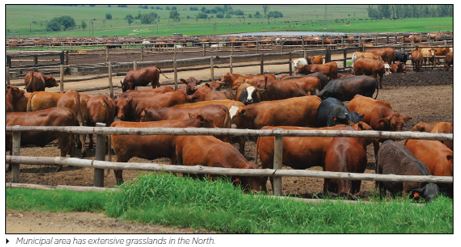
Most industry in the area is associated with agriculture or hand work (carpets, beadwork) by trained artisans. The municipal area has extensive grasslands in the north, supporting the primary agricultural sector based on cattle ranching for beef, small scale sheep and mixed farming and maize cultivation. In the southern areas substantial forestry is prevalent.
Sugar cane and smaller scale fruit farming such as avocado and kiwi fruit cultivation also occur. The area has high potential for growth in agricultural crop production (maize, soybean and sugar cane). In rural areas, particularly at Umsinga and Nquthu, animals are not kept as farming commodities and are seldom slaughtered or sold.
Endumeni Municipality is a key administrative, educational and economic centre for northern KwaZulu-Natal. Endumeni, with the smallest population, but the largest economy of the district, comprises the towns of Dundee, Glencoe and Wasbank, together with several farms. Dundee is the administrative seat of Umzinyathi and can be viewed as a strong regional centre with substantial commercial and agricultural activity.
This municipality is unique; its population is predominantly urbanised or based on commercial farms and unlike the other local municipalities there is no tribal authority land. Endumeni’s diversified economy includes commercial cattle farming, dairy production and tourism.
Dundee and Glencoe form part of the Coal Rim of KwaZulu-Natal, that have over the past decade been negatively affected by a substantial decline in the coal mining sector which previously formed the economic base of the areas.
The Umvoti Municipality comprises urban areas, commercial agricultural areas and tribal authority areas all of which exhibit typical characteristics associated with these settlement types. The main town in the Umvoti Municipality is Greytown. It is the agricultural centre of the district and contributes substantially to the economic viability of the region.
Nquthu Municipality is located along the north eastern boundary of the district, with expansive rural settlements being one of the major features. Nquthu Town is a small urban area that has established itself as the primary commercial, administrative and service centre for the municipality.
Msinga Municipality is largely located in deep gorges of the Tugela and Buffalo Rivers, isolated from the immediate surrounding municipal areas. The population dynamics result in a growing rural area and a declining urban area in Msinga, contrary to other areas in the country. Although the area has its challenges, there are historic sites, beautiful scenery and interesting topography in some parts, suitable for cultural and eco-tourism.